







Why Beko washing machines break down and how it shows
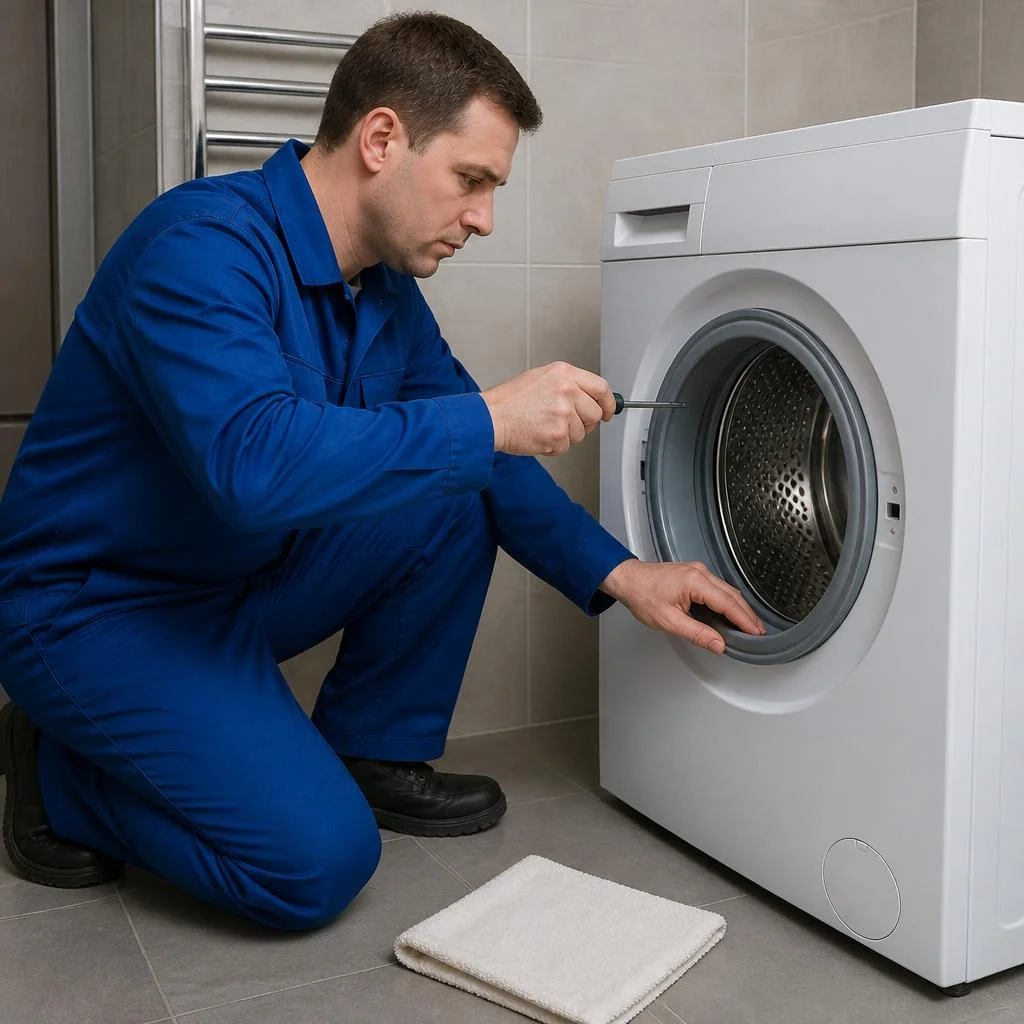
Beko is mass-market appliance with a predictable set of wear items: the pump, the heating element, the bearing assembly, the door seal. Let's look at which symptoms identify a failed component even before the technician arrives.
Typical Beko faults: from "won't drain" to "won't turn on"
- Won't drain water: clogged drain filter, worn drain pump or blocked sewer line — the most common reason for a call-out.
- Won't heat water: scale on the heating element or a broken coil, less often a failed temperature sensor and thermostat.
- Noisy and humming during spin: worn drum bearing, sagging shock absorbers, stretched drive belt.
- Won't turn on: a break in the power circuit, worn power button, failure of the electronic module or control board.
- Leaking under the machine: loss of elasticity of the door seal, a crack in the pump hose, a loose clamp.
- Won't spin: worn motor brushes, stretched belt, sticking program selector.
Beko error codes E01–E18: what they mean
| Code | Component | What to check |
|---|---|---|
| E01 | Drain | Filter, hose, drain pump |
| E02 | Water intake | Inlet valve, pressure switch |
| E03 | Drain | Sewer line, pump, level sensor |
| E04 | Water intake | Valve, mesh filter, hose |
| E05 | Heating | Heating element, temperature sensor, thermostat |
| E09 | Electronics | Control board, ribbon cables |
| E18 | Heating | Heating element, wiring, module |
Why leaks and noise during spin occur
Leaks are most often caused by wear of the door seal or the pump hose, while noise during spin is caused by wear of the drum bearings and shock absorbers. The rubber of the seal loses its elasticity by the 4th–5th year of use, the hose cracks at the bend, and the bearing starts humming after 1500–2000 spin cycles. The second source of noise is sagging shock absorbers: the drum hits the housing, and the vibration is transmitted to the floor. If the noise appears in the 5th–7th year of use, replacing only the bearing is pointless — the spider and the tub are already worn, so the assembly is replaced as a unit. This is exactly how customers often write to the service: Beko washing machine bearing replacement — and the technician immediately understands which component is meant. Restoring Beko washing machines with such symptoms begins with checking the drum play by hand: noticeable shaft movement confirms wear of the bearing assembly even before disassembly.
Beko Washing Machine Diagnostics: How We Identify the Fault
Diagnostics is the first and mandatory stage: without it, any replacement of a component turns into guesswork. Here's how it works with us.
How Beko Washing Machine Diagnostics Are Performed On-Site
- Power and panel: the technician tests the power cord, checks the interference filter, and reads the Beko error code from the display or by the blinking indicators.
- Water intake: the inlet valve, fill level, and water supply pressure are checked — with weak pressure, the machine goes into a fill error.
- Draining: the operation of the pump, the patency of the hose and filter, and the absence of a sewage blockage are tested.
- Heating: a multimeter measures the resistance of the heating element and temperature sensor, and the thermostat circuit is checked.
- Rotation: the drum movement, bearing condition, belt tension, and motor brush wear are assessed.
What the Technician Checks First
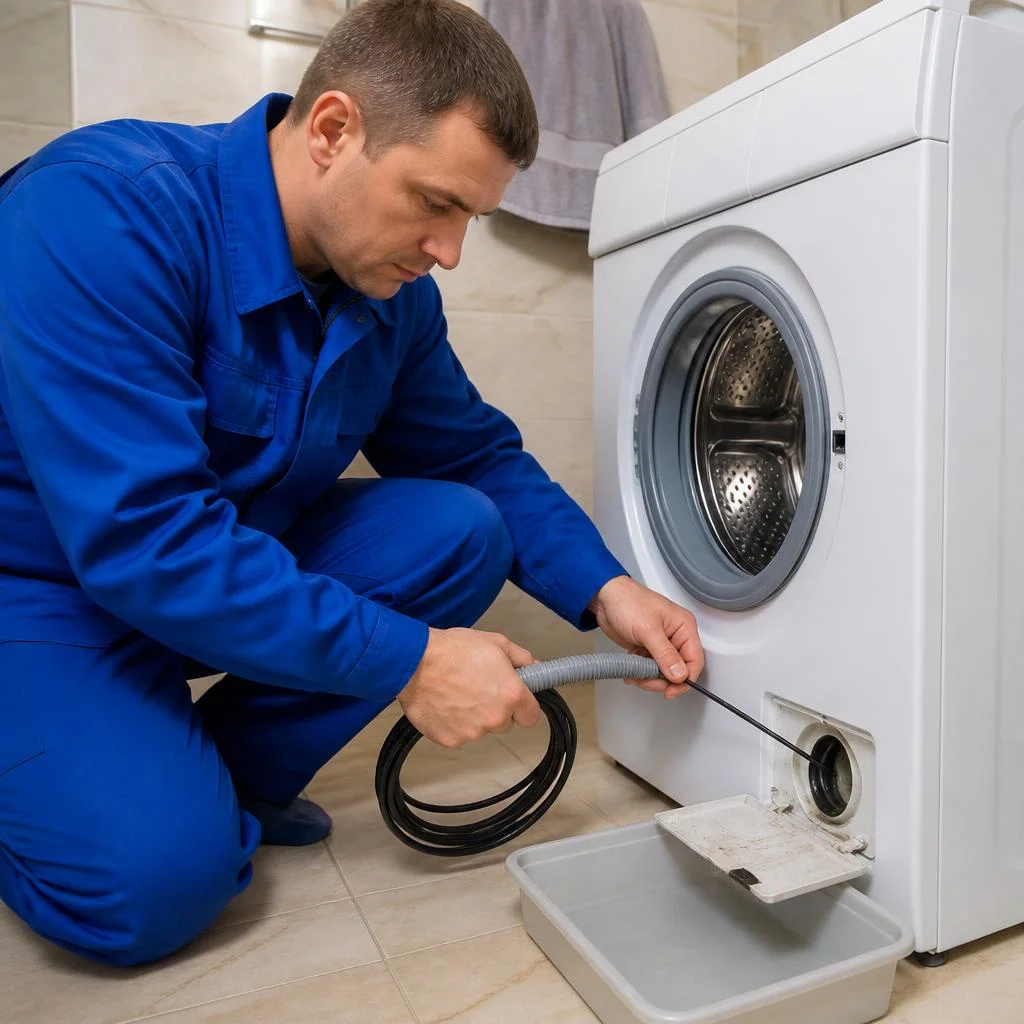
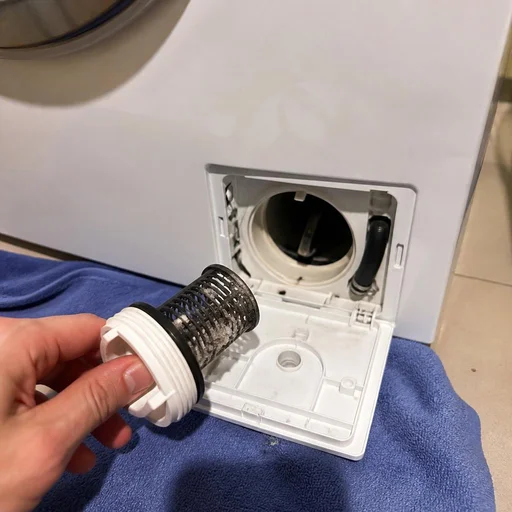
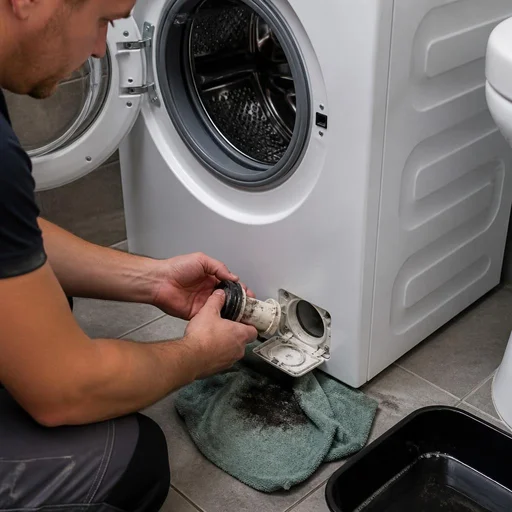
First of all, our technician checks the drain filter, hose, and pump — they account for the majority of calls with the complaint "won't drain water." The filter gets clogged with lint, coins, and small items from pockets, the hose becomes overgrown with soapy deposits, and the pump impeller loses its movement due to a bra underwire getting in. Beko washing machine diagnostics are structured so that simple causes are ruled out first: if the drain is restored after cleaning the filter and hose, replacing the pump is not necessary. We have recorded cases where the client had already agreed to a pump replacement elsewhere, but the problem was solved by cleaning in 20 minutes. Therefore, before any replacement of a component, demand a test report: winding resistance, sensor readings, error code — otherwise, restoring a Beko washing machine turns into swapping parts at your expense.
When On-Site Repair Is Impossible and a Service Center Is Needed
Replacing bearings, the tank assembly, and the spider requires disassembling the machine and a press — such work is performed in our own service center in Moscow. Up to 80% of calls can be handled on-site: pump, heating element, door seal, belt, control board, button, and selector. Major restoration with pressing out bearings and replacing the spider cannot be done in the air: the Beko tank is composite, it warps when skewed, and after reassembly, drum runout appears. The workshop has a spin test stand and a tank for leak testing, which cannot be set up in an apartment. In search, clients often type "Beko washing machine repair" — and end up here, although in fact they don't need on-site parts replacement but a full disassembly on the stand. If a technician offers to replace bearings right in the bathroom, it's worth asking how he plans to press out the race and center the shaft.
Replacing Beko components: what we replace and when
We break down the key replacements: what symptoms they are prescribed for, what is included in the work, and why a component is replaced as a complete assembly rather than in parts.
Replacing the bearing of a Beko washing machine: when it is needed
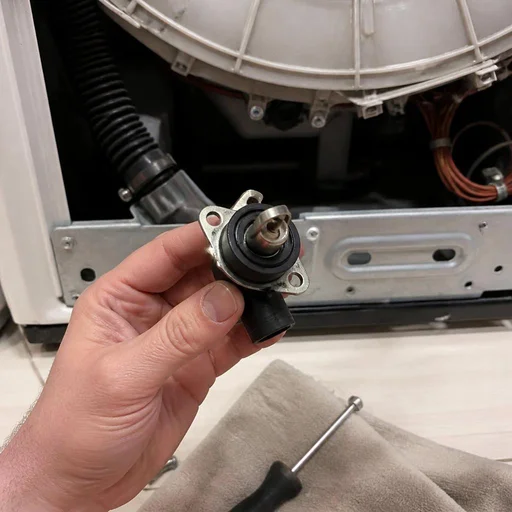
Replacing the bearing of a Beko washing machine is needed when there is a hum and vibration during the spin cycle, and Beko bearing replacement always goes together with the seal, otherwise the assembly will fail again. The hum grows with the RPM: at 400 RPM it is barely audible, at 1000–1200 RPM it turns into a roar, and a rusty streak from the destroyed seal appears on the edge of the tub. During disassembly it is clear that water has washed out the lubricant and pitted the raceway of the bearing ring; on models with a non-separable tub this immediately means replacing the tub as a complete assembly, not just the bearings. The bearing is replaced as a pair — front and rear; saving on one leads to the second failing after 2–3 months, and the work has to be paid for twice. If, when turning the drum by hand, a crunching is heard and the spider is covered with a white deposit, disassembly cannot be postponed — the shaft begins to strike the seal and damages the seat.
Replacing the heating element in a Beko washing machine and descaling
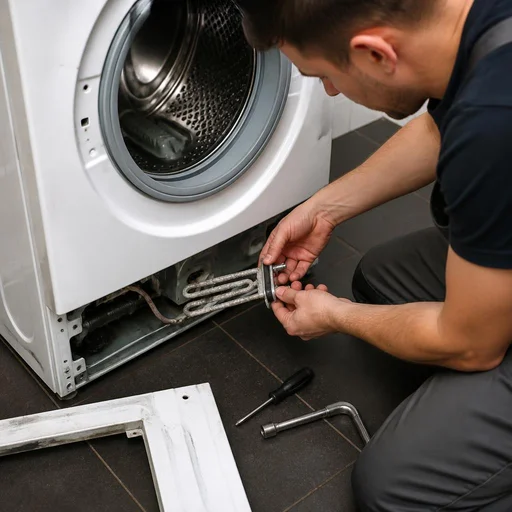
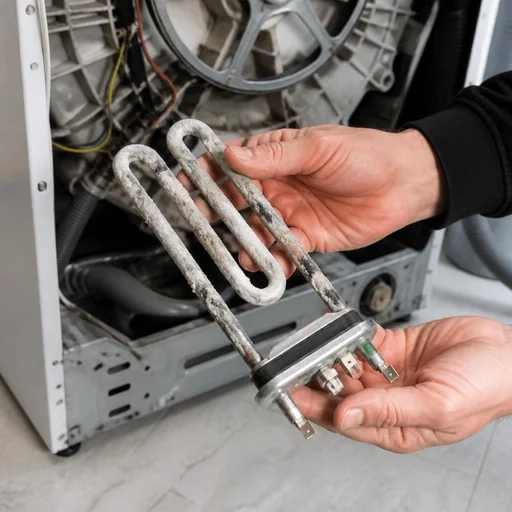
Replacing the heating element in a Beko washing machine is required when the water does not heat up or the machine trips the breaker: we install an original heater and at the same time remove scale from the tub. The symptoms differ by code: E05 indicates the level sensor, while "the wash runs with cold water" without an error indicates a broken coil or a stuck temperature sensor. Scale is the cause of overheating and breakdown of the heating element; if it is not removed during replacement, the new heater will fail faster than its stated service life. The heater is checked with a multimeter for resistance and for a short to the body, the thermostat and temperature sensor — separately, because during a voltage surge they fail together with the heating element. In hard water, scale accumulates over 8–12 months, so during the first replacement of the heater it makes sense to treat the tub against deposits right away.
Replacing the door seal of a Beko washing machine and sealing the tub
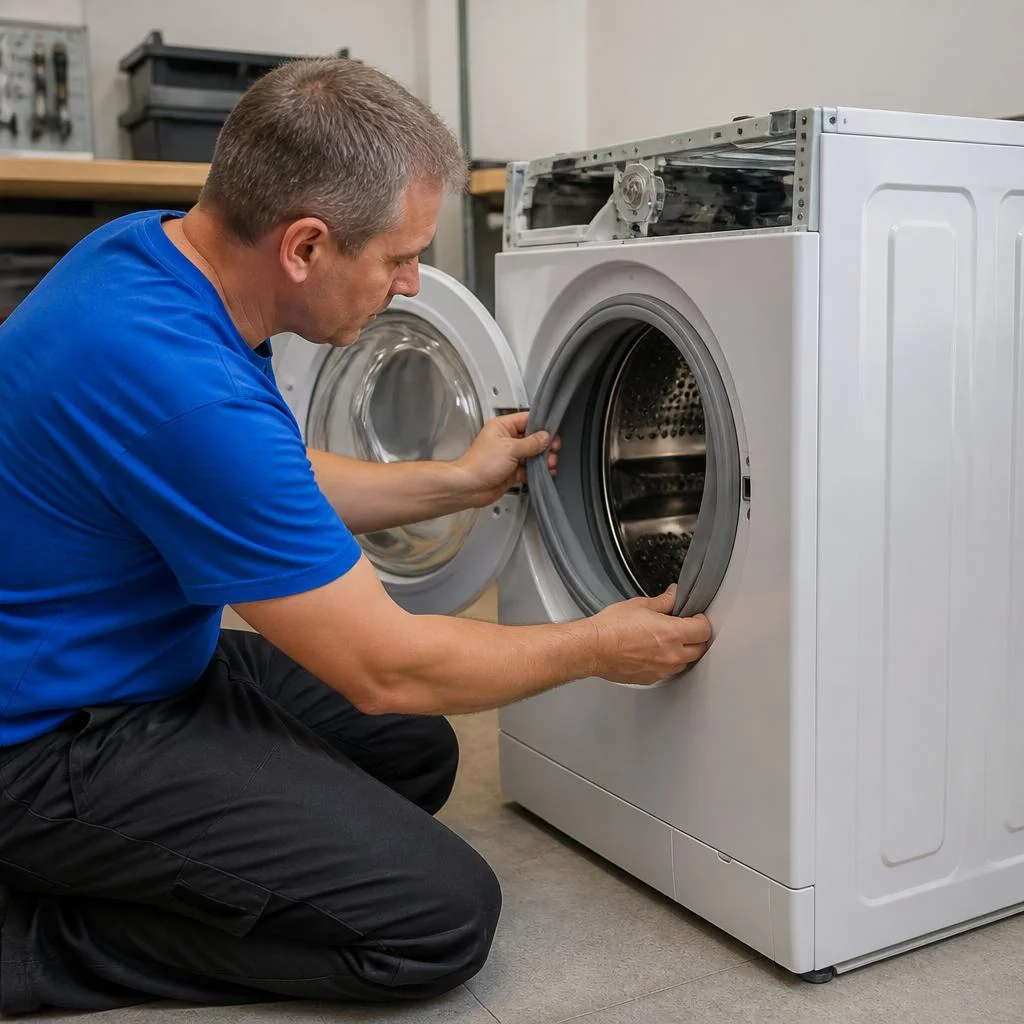
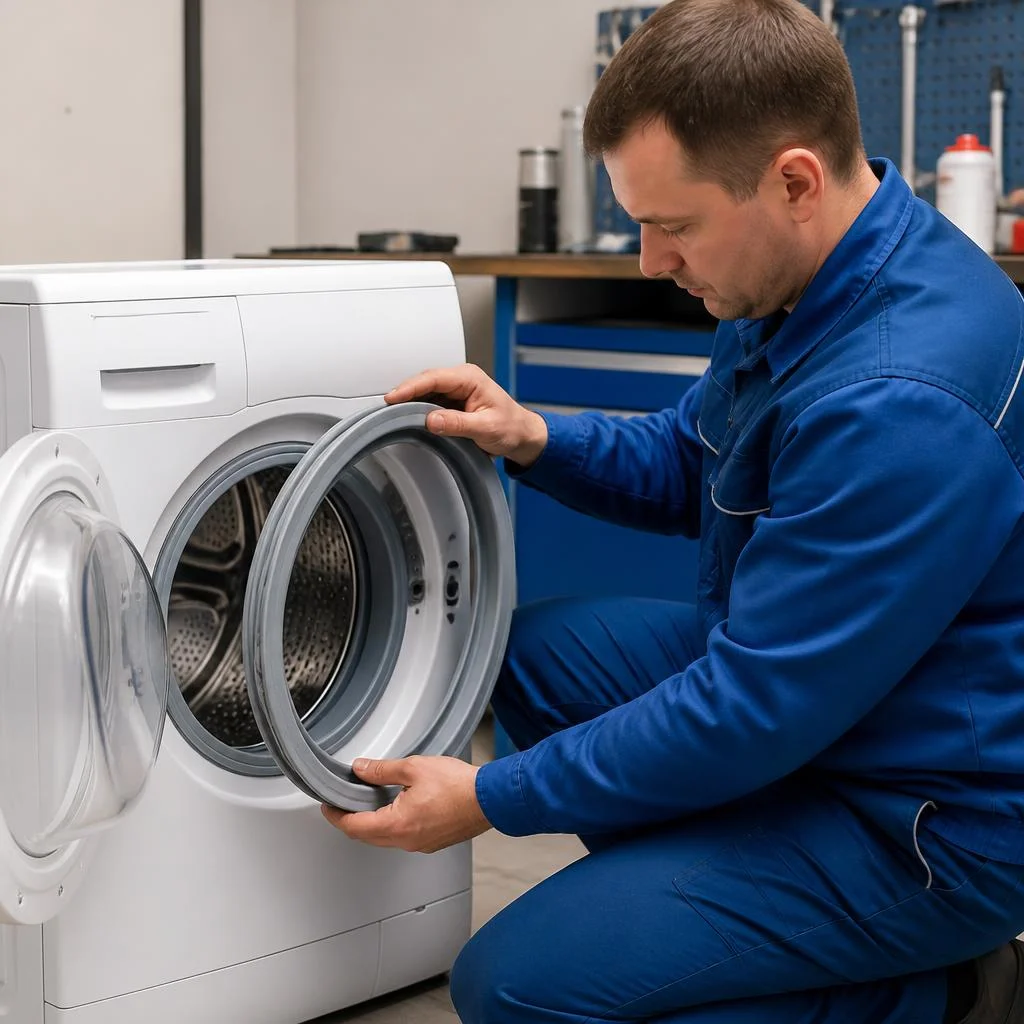
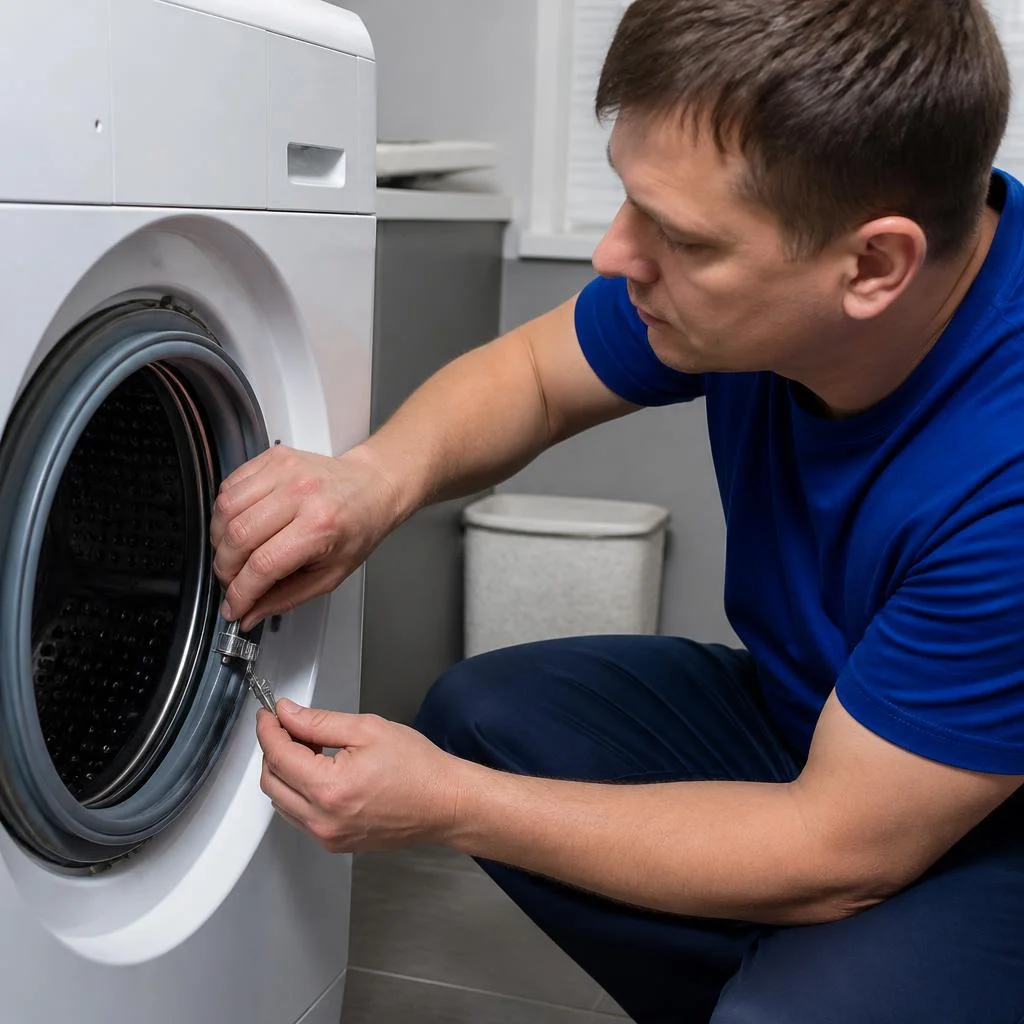
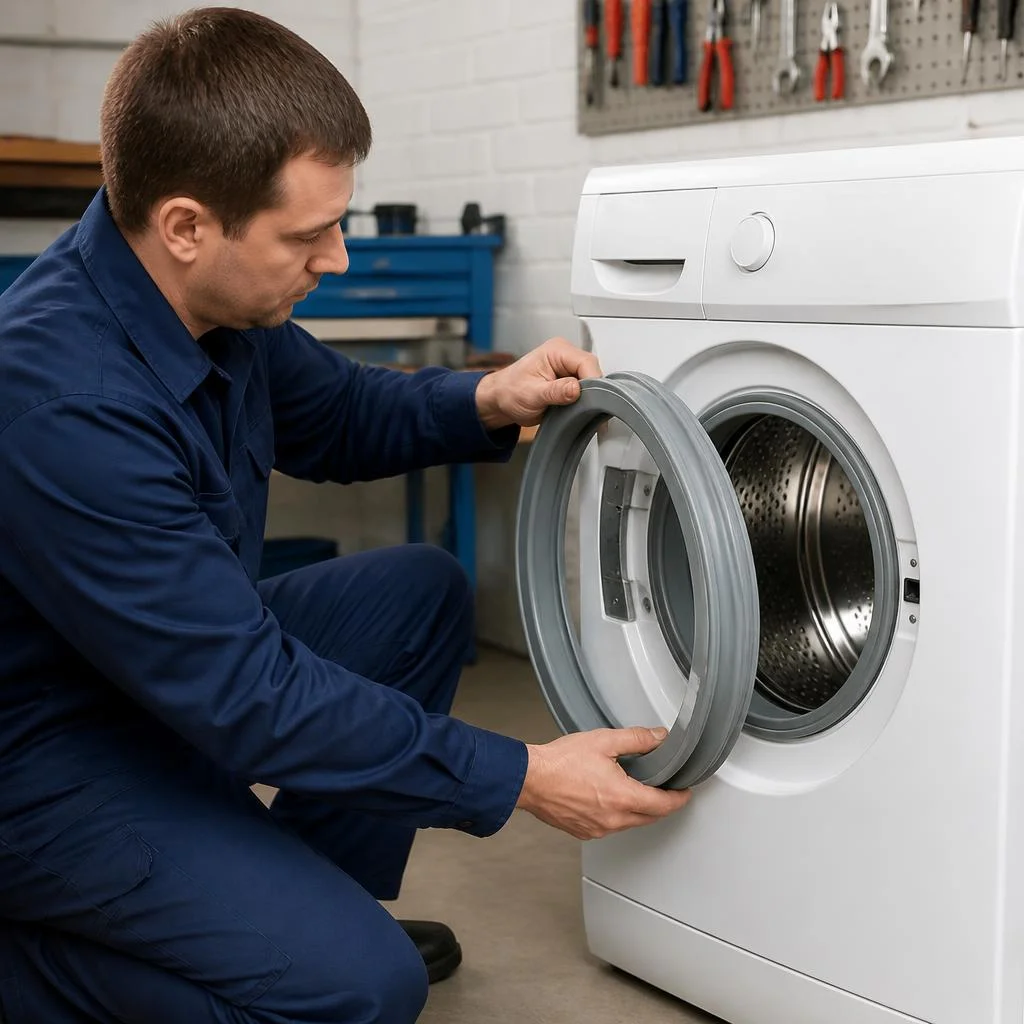
Replacing the door seal of a Beko washing machine eliminates leaks along the edge of the door: we remove the old seal, check the seat, and install a new seal with sealant. The rubber loses its elasticity over 5–7 years, cracks along the fold, and lets water through down the front wall — a puddle appears on the floor under the machine after every spin. This is exactly how people often write to the service: replacement of the door seal of a beko washing machine — and the technician immediately understands what is meant, although in fact the work covers the entire door contour. The seal is replaced together with checking the pump hose and clamps: if a loose clamp is left, water will seep through the joint even with a new seal. A separate case is replacing the door handle of a Beko washing machine: the plastic tab breaks when the door is slammed shut, and the door stops locking, which is why the wash does not start. Before installing a new seal, the technician cleans the seat groove of deposits and applies a thin layer of sealant — this way the seal sits tightly and does not shift during the spin cycle.
Replacing the drain pump and clearing a sewage blockage
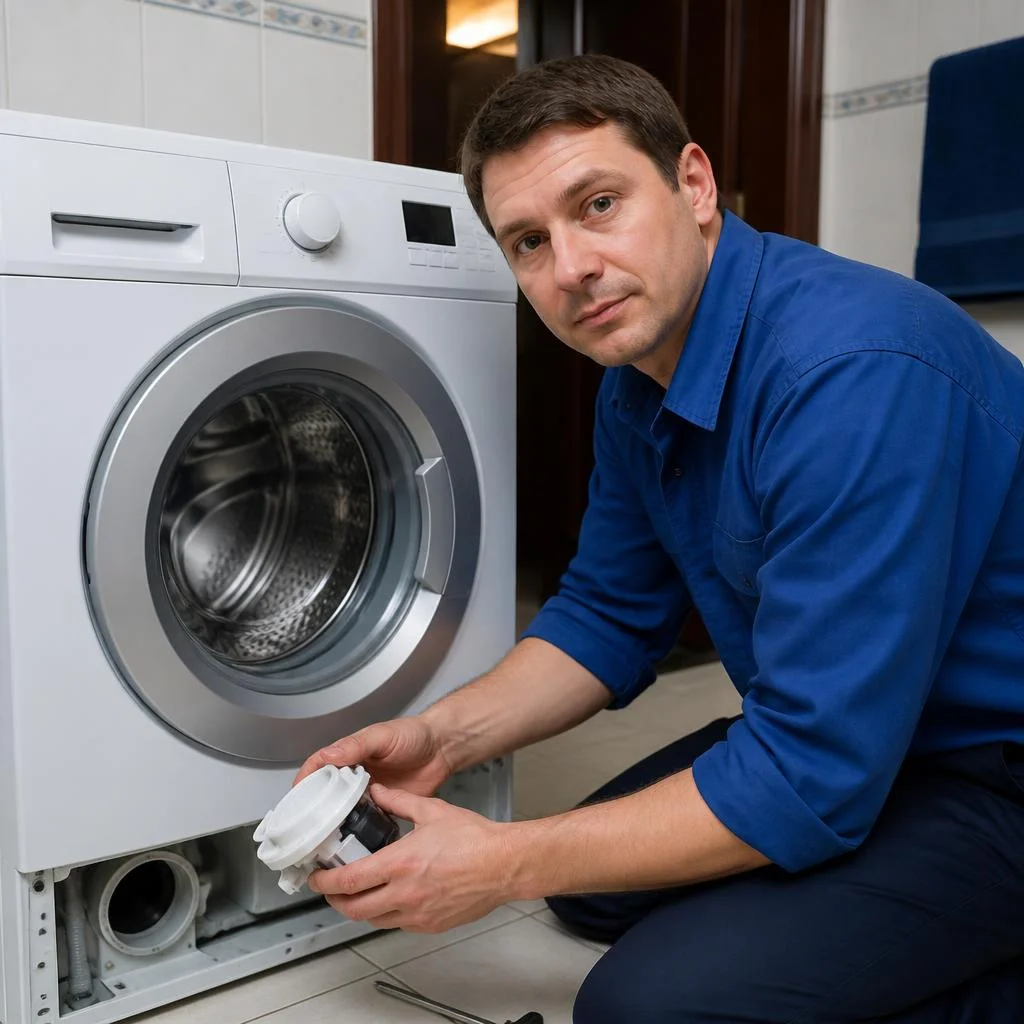
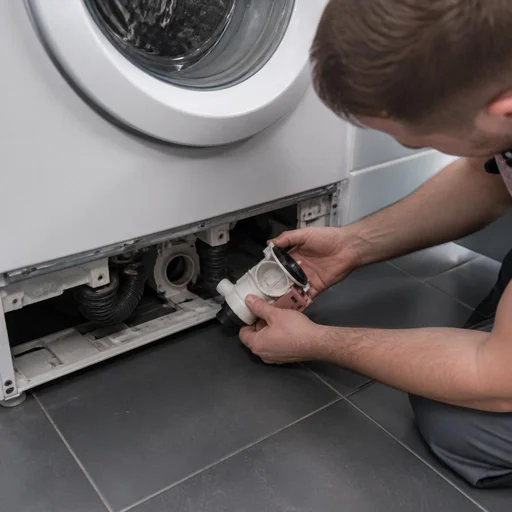
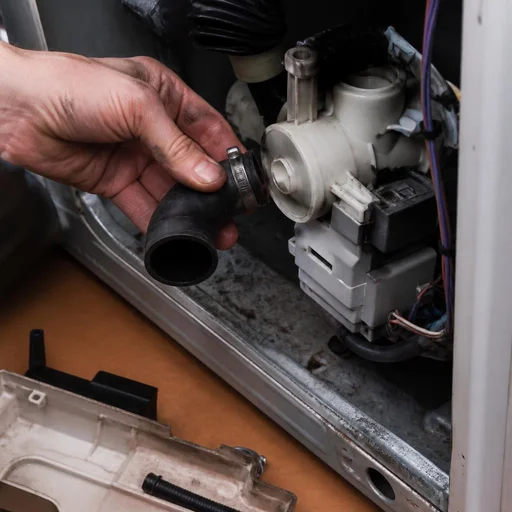
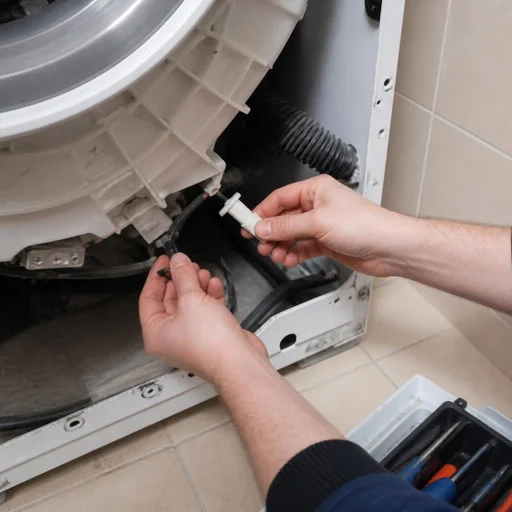
Replacing the drain pump is needed when the pump hums but does not pump out water: we replace the pump and at the same time clear the sewage blockage if the cause is a clogged drain. The check takes minutes: the technician removes the drain filter, inspects the impeller through the pump hose, and listens to the pump under load. Before replacing the pump, the filter and hose are always checked — in half the cases the "dead" pump turns out to be working, and the drain is blocked by a foreign object: a bra underwire, a coin, a clump of lint. If the impeller turns with effort or shows scoring, the pump is replaced; if the part is intact but the water stands still, the drain is cleared and the corrugated hose is checked for kinks. A sewage blockage in the riser is cleared separately, otherwise after replacing the pump the water will flow back again on the very first cycle.
Repairing the control board and replacing the electronic module
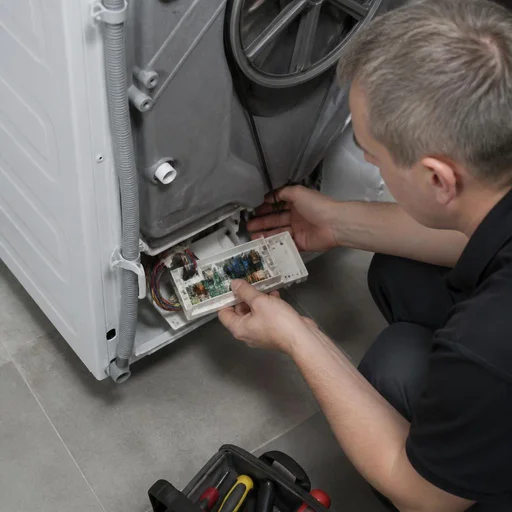
Repair of the Beko control board is performed when programs fail and the panel is "dead": we diagnose the module and either restore it or replace the electronic module with a compatible one. The board often suffers not on its own, but due to voltage surges or a leak — without eliminating the root cause, the new module will fail again. Typical symptoms: the panel does not turn on, the program selector does not work, the machine freezes mid-cycle, the power button does not respond to pressing. During repair, the traces, triacs and capacitors are checked under a microscope; if restoration is not cost-effective, a module with the same firmware for the specific model is installed. Before replacing the module, the technician inspects the door seal and the inlet valve — after a leak, moisture gets onto the board, and without fixing the leak the work will have to be repeated.
Replacement of shock absorbers, belt and motor brushes
| Assembly | Symptom | What we replace |
|---|---|---|
| Drum shock absorbers | The body jumps and "travels" during spinning | Shock absorbers as a pair, check of suspension springs |
| Drive belt | The drum does not rotate, the motor hums | Belt, inspection of the drum pulley |
| Motor brushes | Spark, the machine loses power during spin-up | Brushes, check of the commutator |
| Drum pulley | Whistling, belt slipping | Pulley when the seat is worn |
Replacing the shock absorbers of a Beko washing machine eliminates body jumping during spinning, replacing the drive belt restores drum rotation, and replacing the motor brushes restores power and stable spin-up. Shock absorbers are replaced as a pair and together with a check of the suspension springs — a single replacement causes the tub to skew and accelerates bearing wear.
Beko washing machine repair at home: how the visit works
Most Beko repairs are completed at home in a single visit. Here's how to book, what to prepare, and how the visit goes.
How to call a technician and what to prepare
- Model and series: copy down the rating plate on the door — WRE, WKB or EV 7100, this determines component compatibility.
- Error code: note the combination from the display (E01–E18) — the technician will use it to select the part before the visit.
- Symptom: describe it in words — won't drain, noisy during spin, won't fill with water, leaking from underneath.
- Access to the machine: clear the approach to the door and the water supply tap, remove the mat and basket.
- Power and drainage: check that the socket works and that the drain hose is not pinched and leads into the sewer.
Connecting a Beko washing machine after repair
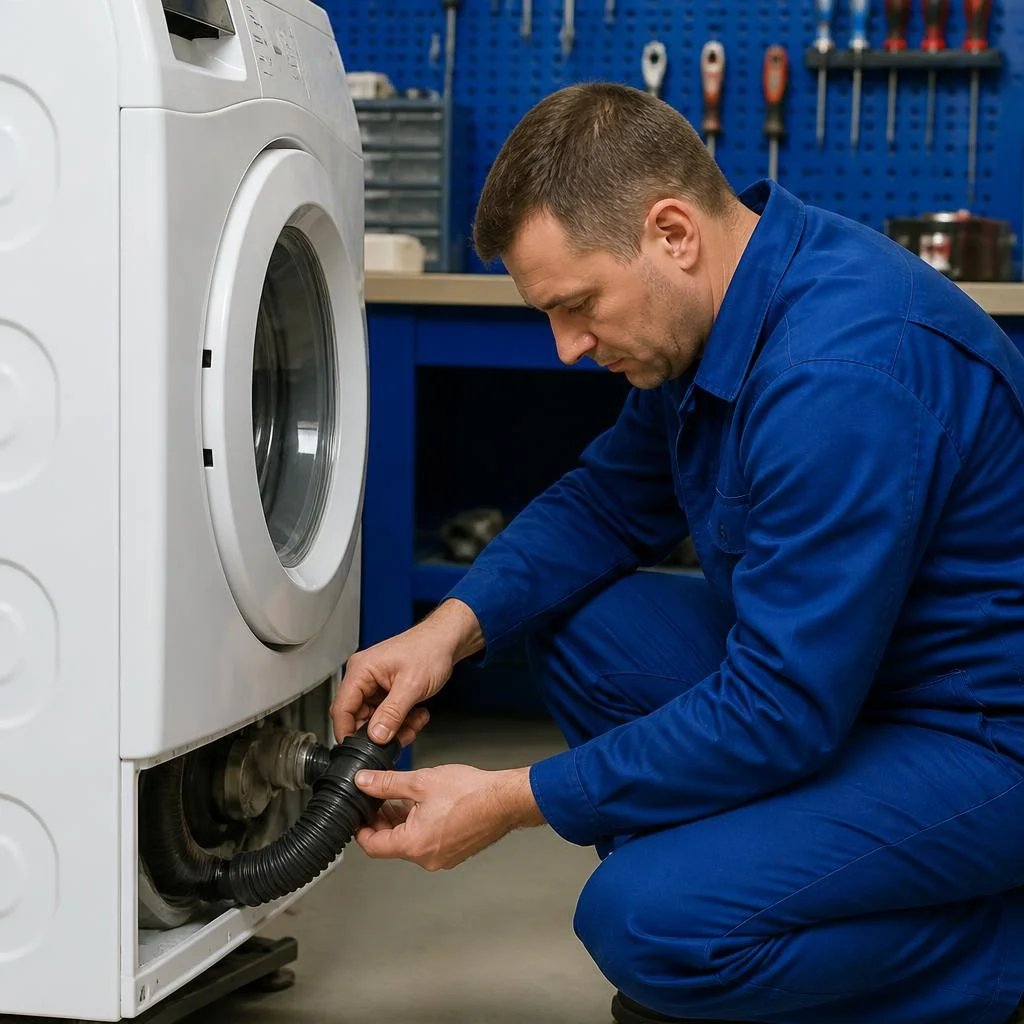
Connecting a Beko washing machine after repair is done on site: the technician connects the inlet hose, checks the drain into the sewer and tests the cycle for leaks. The inlet hose is attached to the valve via an Aquastop, and the inlet mesh filter is rinsed of rust and sand — otherwise the water inlet valve clogs within 3-4 months. The drain hose is routed into a siphon or standpipe with a loop at a height of 60-90 cm, so that dirty water does not flow out by gravity during washing. The slope of the drain hose is checked separately — if there is none, water from the sewer can be sucked back, and the machine will smell even after cleaning.
How many visits are needed and what it depends on
Most Beko repairs are completed in one visit: the technician arrives with standard spare parts, and rare components are delivered on a second visit to order. This is exactly how people often write to the service — Beko washing machine repair — and the technician immediately understands what is meant. Beko washing machine servicing at home is completed in 8 out of 10 cases — this is replacement of the pump, heating element, door seal, motor brushes and hoses. The remaining 2 cases require a second visit: the drum spider, the complete tank assembly and the electronic module for a specific series are brought to order. The second visit is usually related not to the work, but to the logistics of a rare spare part — so it is better to provide the exact model and error code when placing the request. In Moscow, the technician visits on the day of the request, and fixing a standard fault takes 1-2 hours on site.
Warranty, spare parts and payment: Eco-Service terms
The terms of service are part of the service. We set out what the warranty covers, where the spare parts come from and how the work can be paid for. Below are the three points most often clarified before the technician's visit.
2-year warranty on completed work
Eco-Service provides a 2-year warranty on completed work and installed spare parts — the term is recorded in the work order and does not depend on the Beko model. The countdown starts from the date of signing the acceptance certificate: the same period applies to replacement of drum bearings, the heating element, the drain pump, the door seal and motor brushes. This is often exactly how people write to the service: replacing the bearing of a Beko washing machine — and the technician immediately understands which unit is meant, even if the client does not name the model index. If, after a beko washing machine repair has already been carried out, it again shows an error on the same unit, the technician comes out again under warranty. The warranty is valid subject to compliance with operating conditions: if the machine was overloaded or connected independently in violation of the wiring diagram, the case is reviewed separately.
Original Beko spare parts and model compatibility
Eco-Service installs original Beko spare parts, selected according to the WRE, WKB and EV 7100 model ranges — this preserves the service life of the unit and compatibility with the electronics. For replacement we use the drain pump, heating element, drum bearing, door seal and the spider assembly with drum: we verify part numbers against the manufacturer's service documentation for the specific model index, and not by the external similarity of the part. Cheap analogues of pumps and heating elements often differ in mounting dimensions and power — the saving results in a repeat call-out sooner than expected.
Payment by card and cash, documents after repair
- Payment by card and cash: we accept both methods, including transfer via the SBP, immediately after acceptance of the work.
- Work order: we issue a document listing the work, the installed spare parts and the 2-year warranty period on the completed work.
- Cashless payment: for organisations we issue an invoice and closing documents.
- Warranty card: keep it together with the receipt — a repeat visit is arranged on its basis, and without it the review of the case is delayed.
Beko Washing Machine Repair in Moscow: Service Center and On-Site Visits
The capital has its own service center where you can bring the machine in person, and a home visit by a technician is also available. Let's break down how the formats differ and what to look for when choosing a service provider.
Own Service Center: What It Offers
Servicing Beko washing machines in Eco-Service's stationary workshop allows for major repairs — replacement of bearings, the drum assembly, and the spider — using press and test-bench equipment, rather than working freehand in the client's bathroom. Press-fitting the drum bearing requires alignment: a misalignment of 0.2-0.3 mm causes runout, humming during spin cycles, and a repeat teardown of the drum six months later. The workshop has a hydraulic press, mandrels sized for Beko's mounting dimensions, and a test bench for running the drum under load — the assembly is checked before the machine is reassembled. The spider is replaced with a check of shaft play and seal condition, not just swapping out the part. Clients often phrase their request as Beko washing machine repair at home, but major restoration of the assembly is only possible in the workshop: if a technician takes on bearings at home without a press, the risk of returning to the same breakdown is high.
Technician Visits Across Moscow: Zones and Work Format
Eco-Service provides on-site visits throughout Moscow: the technician arrives with tools and common spare parts — pumps, heating elements, door seals, belts — and delivers complex assemblies from the service center when needed. We work both within the MKAD and in areas beyond the ring: Khimki, Balashikha, Odintsovo, Lyubertsy, Mitino, Novo-Peredelkino. According to our order statistics, around 60% of faults are resolved on the first visit — these are drainage issues, heating problems, door seal leaks, and clogged filters. People often search for Beko washing machine repair — and for such a request, the technician arrives with the same set of tools as for other brands. We perform diagnostics on the spot: testing the heating element, checking the pump, reading the error code from the board. If the machine is in a narrow bathroom, it's worth clearing access to the rear panel in advance — this saves visit time and reduces the risk of damaging the finish.
How to Choose a Service Provider
- Own service center: having a workshop with a press and test bench shows that the provider is ready to take on bearings and drum assemblies, not just minor components.
- 2-year warranty on work: the term is specified in the work order; the wording "warranty on the part" without a term for the work is a reason to clarify the conditions.
- List of spare parts in the order: original Beko parts are listed with part numbers, compatible ones are marked as such, so there's no later dispute about the part's origin.
- Documents and payment: a receipt, a work completion act, and a work order listing the operations — without these, there's no basis for a warranty claim.
- Reviews on Yandex.Maps and 2GIS: look not at the rating but at descriptions of specific work — bearing replacement, board repair, leak elimination; Beko washing machine repair is assessed in reviews specifically by the description of operations.
Conclusion
Beko washing machine repair is a task where accuracy of diagnostics and quality of spare parts matter more than speed. We've gathered the key points to keep in mind before contacting any service.
Key Takeaways
- Diagnostics come first: without checking the module, pump, and bearings, replacing a component at random leads to a repeat visit a month later.
- Original spare parts: compatible alternatives save money upfront but wear out 1.5-2 times faster and cause secondary leaks.
- 2-year warranty: a term covering both work and parts confirms that the technician is confident in the result and isn't shifting risks onto the client.
- Error codes are a hint, not a diagnosis: E01 and E18 point to an assembly, but the exact cause is revealed by a multimeter and disassembly of the drum.
- Prevention is cheaper than repair: cleaning the filter and heating element once every 8-12 months extends the machine's life by 3-4 years.
- Documents after work: an act listing completed tasks and replaced parts is the basis for a warranty claim.